Drawing Performatively
Tracing Out
Tracing Out
Tracing Out
Solo performances
Ritmo en Capa (Rhythm in Layers) (2026)
‘Ritmo en Capa’ is a performative drawing that emerges from the encounter between body, time and matter. Conceived specifically for the exhibition of the same name held at the Fundación Canaria de Arte Tranche, the work transforms action into a tool for inscription. On a large-format raw canvas, the artist performs a sequence of repetitive movements inspired by dance, establishing a direct relationship between gesture, rhythm and line. Each movement is linked to a different drawing material, generating layers that record not only an image, but also the physical memory of its execution. The result is a surface traversed by traces, intensities and variations that reveal the duration of the action and the presence of the body in space.

Still frame from the video documentation.

Still frame from the video documentation.

Still frame from the video documentation.
Still frame from the video documentation.
A Ras de Suelo (At Ground Level) (2026)
In this work, based on the act of sweeping (usually associated with the everyday and the invisible), the artist, together with another collaborator, sweeps a significant material across the space using palm fronds: These are the remains of the charcoal used in a participative performance carried out in this very same space the former year (Resonant Connections: Echoes of a Collective Line), in which around 60 people took part. The decision to use this specific charcoal connects the new action with a previous shared moment, recycling material and memory and establishing a new dialogue. As the action progressed, each of the performers altered the lines drawn by the other. No specific or fixed result is sought; the forms appear only to be immediately altered, emphasising the ephemeral and provisional nature of the drawing. The work thus invites reflection on labour, care, listening and mindfulness.

Photo by Andrés Gutierrez.

Still frame from the video documentation. Filmed and Edited by Alejandro Marante.
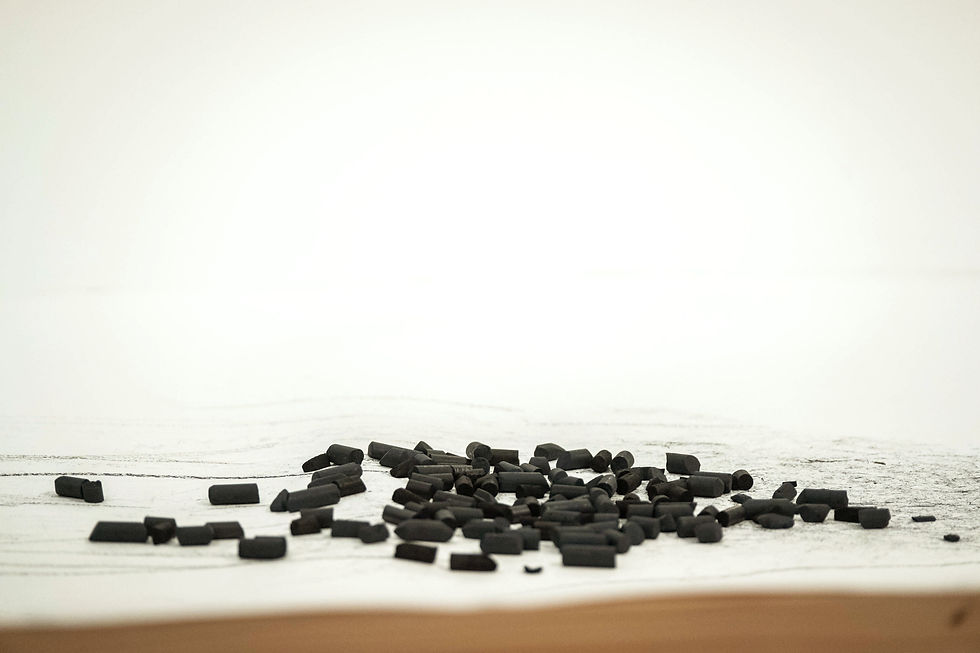
Photo by Andrés Gutierrez.
Photo by Andrés Gutierrez.
200 Gestures: Line - Dot - Volume (2022)
The work addresses a reflection on the intersection of the languages of drawing, performance and sculpture. The main component of the work is pencil, a material traditionally associated to drawing. The artist holds a pencil (which conceptually represents a line), breaks it in half (conceptually representing a dot), and then places the two halves in a polystyrene box. This action is repeated 200 times. As pencil halves pile up they build a volume, moving therefore into the sculpture realm. The work also poses a dialogue between contemporary art practices and historical art movements, such as body art, minimalism, process art and concept art.

Performative sculpture. 20 x 20 x 20 cm.

Performative sculpture. 20 x 20 x 20 cm.
Performative sculpture. 20 x 20 x 20 cm.
New Flesh Series (2021)
Inspired by Rebecca Horn’s work, as well as the philosophy of Jean-Luc Nancy - which posits the body as something subject to constant evolution and redesign by both the natural and the artificial - the series ‘New Flesh’ explores the making of performative drawings through the use of objects made specifically for each performance. These objects act as ‘prostheses’, elongating the body and expanding its capabilities while acting as a constraint in the creative process.
'Medusa'

Image of performance. Photo by Rafael Arocha.

Image of performance. Photo by Rafael Arocha.

Close up view of drawing device. Photo by Rafael Arocha.
Image of performance. Photo by Rafael Arocha.
'Harpy'

Image of performance. Photo by Rafael Arocha.

Image of performance. Photo by Rafael Arocha.

Installation view. Photo by Rafael Arocha.
Image of performance. Photo by Rafael Arocha.
'Centaur'

Performance still. Photo by Rafael Arocha.

Performance still. Photo by Rafael Arocha.

Installation view. Photo by Rafael Arocha.
Performance still. Photo by Rafael Arocha.
Smashed Bouquet (2023)
In this performance drawing M.Lohrum smashes repeatedly a sticky mixture of graphite on a piece of paper placed vertically on the wall. The artist's interest in generating contrasts results unmistakable in this work, in which such violent performance gererates a beautiful image that recalls a flower bouquet. The work was created originally in 2018, but was re-performed in 2023.

Centro de Arte La Regenta, 2023. Photo by Rafael Arocha

Centro de Arte La Regenta, 2023. Photo by Rafael Arocha

Centro de Arte La Regenta, 2023. Photo by Rafael Arocha
Centro de Arte La Regenta, 2023. Photo by Rafael Arocha
Matsutani's Pond (2021)
'The work is inspired by 'A Matrix' by Takesada Matsutani. It poses a collaboration between artist and Nature. To make it, M.Lohrum worked on a frame containing water and six volcanic rocks, which she placed horizontally on the grass in the middle of a garden so that it resembled a pond. Then, she wiped a block of Chinese calligraphy ink on the rocks, causing the ink to gradually spread through the water until it covered the canvas inside the frame. Once the performance was over, she left the frame outdoors for a week, allowing Nature to do its part. When the water had evaporated with the help of the sun and wind, the canvas revealed the resulting drawing.

Performance still

Performance still

Post performance image
Performance still

The Trace that is Left (2020-2021)
The project reflects on the new behaviours and circumstances - hygiene habits, social relations, mourning, etc. - that we have had to face and internalise in our daily lives during the pandemic caused by Sars-Cov 2. The project proposes a reflection on these issues through a series of pieces, in which routines and objects related to the pandemic have been extrapolated to the creative process through which the works have been made, making a poetic reference to the impact of the pandemic on our daily lives.
'20 seconds'
'Put some Lipstick On'

Performance still

Performance Still

Performance still
Performance still

Performance still

Performance still

Performance still
Performance still

Performance still

Performance still

Performance still
Performance still
'2 Meters'
'To Dust We Shall Return'
Long Jump (2017)

Long Jump is a performative drawing made at Central Saint Martins in 2017, and represented the artist in the Degree Show. In this work the artist spreads graphite powder on a massive piece of paper by running and sliding along it in a repetitive elliptical movement for 11 minutes and 36 seconds, until graphite powder is completely spread. The resulting drawing shows the trace of her performance, where the organic character of her movements and footprints intermingles with the specific textures and architectural features of the floor, which result transferred and integrated in the drawing by the frottage of her slipping.